The Art of Persuasion: Aristotle’s Rhetoric for Everybody
Scott F. Crider
Introduction by Hamza Yusuf
Hardback
9780985565985
The liberal arts of language — grammar, logic, and rhetoric — remain fundamental to a liberal education. Even so, although there are innumerable good introductions to the first two arts, there are fewer ones to rhetoric. Scott Crider remedies this in The Art of Persuasion: Aristotle’s Rhetoric for Everybody by offering a simple, clear introduction to the art of rhetoric. He uses Aristotle’s Rhetoric to explain the nature and the parts of the art to the student and general reader who may not yet be ready to read Aristotle’s treatise itself.
After defining and explaining what the art is — and why, counterintuitively, rhetoric is a good thing — the book examines the five subarts of rhetoric: invention, organization, style, memory, and delivery.
Throughout the work, Crider draws on ancient rhetorical masterpieces — especially Plato's Apology and Thucydides’ Peloponnesian Wars — to illustrate the rhetorical principles explained, then asks the reader to apply those principles to Abraham Lincoln’s exemplary “Letter to Mrs. Bixby.” Crider concludes with a reflection on the central place of the art of rhetoric in the trivium, and in liberal education more broadly understood. Three appendices—two study guides and a bibliography—make the book an ideal resource for anyone interested in learning the art of persuasion.
Product Information
Product Information
Shipping & Returns
Shipping & Returns
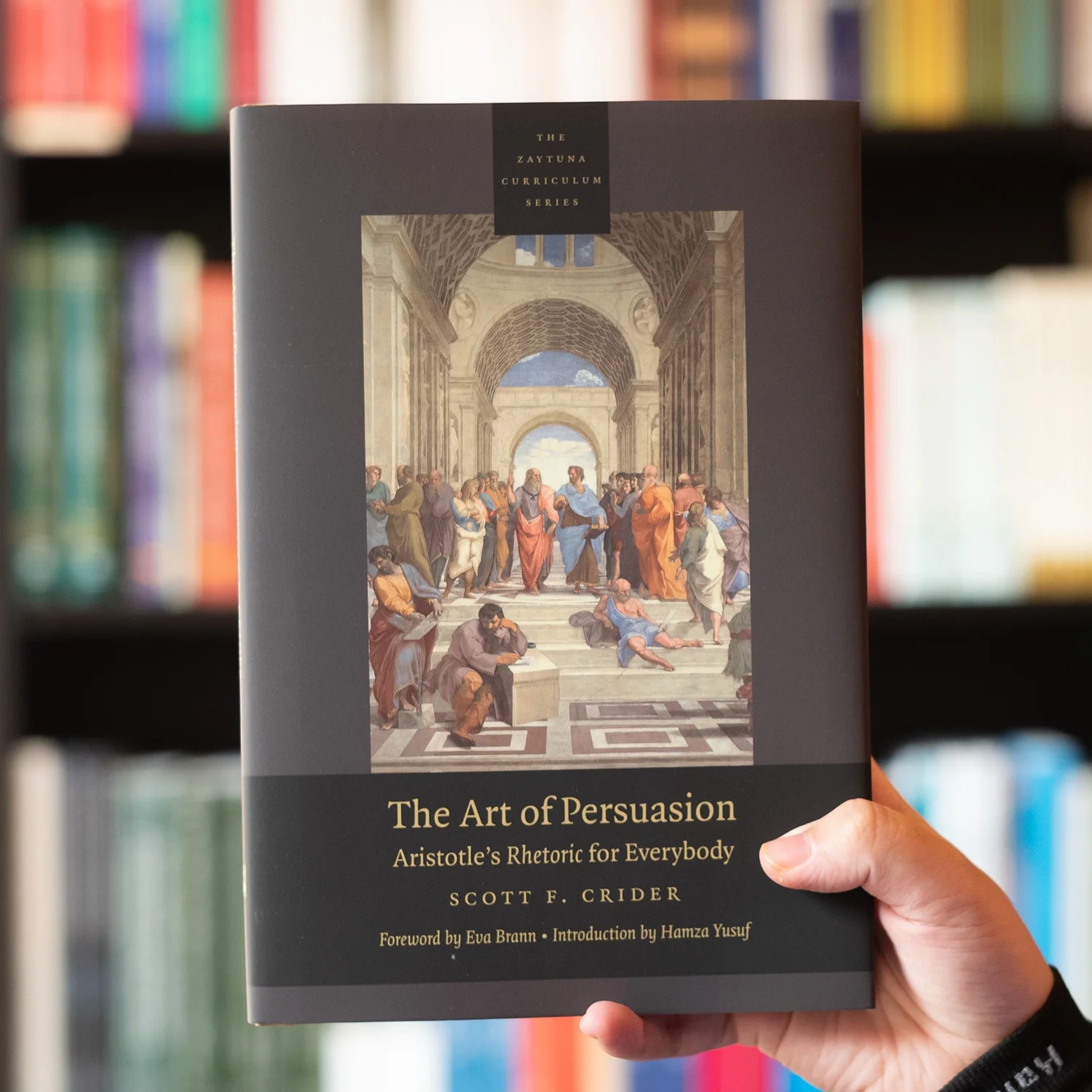
The Art of Persuasion: Aristotle’s Rhetoric for Everybody
The Art of Persuasion: Aristotle’s Rhetoric for Everybody
Scott F. Crider
Introduction by Hamza Yusuf
Hardback
9780985565985
The liberal arts of language — grammar, logic, and rhetoric — remain fundamental to a liberal education. Even so, although there are innumerable good introductions to the first two arts, there are fewer ones to rhetoric. Scott Crider remedies this in The Art of Persuasion: Aristotle’s Rhetoric for Everybody by offering a simple, clear introduction to the art of rhetoric. He uses Aristotle’s Rhetoric to explain the nature and the parts of the art to the student and general reader who may not yet be ready to read Aristotle’s treatise itself.
After defining and explaining what the art is — and why, counterintuitively, rhetoric is a good thing — the book examines the five subarts of rhetoric: invention, organization, style, memory, and delivery.
Throughout the work, Crider draws on ancient rhetorical masterpieces — especially Plato's Apology and Thucydides’ Peloponnesian Wars — to illustrate the rhetorical principles explained, then asks the reader to apply those principles to Abraham Lincoln’s exemplary “Letter to Mrs. Bixby.” Crider concludes with a reflection on the central place of the art of rhetoric in the trivium, and in liberal education more broadly understood. Three appendices—two study guides and a bibliography—make the book an ideal resource for anyone interested in learning the art of persuasion.
Original: $32.78
-70%$32.78
$9.83Product Information
Product Information
Shipping & Returns
Shipping & Returns
Description
Scott F. Crider
Introduction by Hamza Yusuf
Hardback
9780985565985
The liberal arts of language — grammar, logic, and rhetoric — remain fundamental to a liberal education. Even so, although there are innumerable good introductions to the first two arts, there are fewer ones to rhetoric. Scott Crider remedies this in The Art of Persuasion: Aristotle’s Rhetoric for Everybody by offering a simple, clear introduction to the art of rhetoric. He uses Aristotle’s Rhetoric to explain the nature and the parts of the art to the student and general reader who may not yet be ready to read Aristotle’s treatise itself.
After defining and explaining what the art is — and why, counterintuitively, rhetoric is a good thing — the book examines the five subarts of rhetoric: invention, organization, style, memory, and delivery.
Throughout the work, Crider draws on ancient rhetorical masterpieces — especially Plato's Apology and Thucydides’ Peloponnesian Wars — to illustrate the rhetorical principles explained, then asks the reader to apply those principles to Abraham Lincoln’s exemplary “Letter to Mrs. Bixby.” Crider concludes with a reflection on the central place of the art of rhetoric in the trivium, and in liberal education more broadly understood. Three appendices—two study guides and a bibliography—make the book an ideal resource for anyone interested in learning the art of persuasion.